Stonger Together: Beyond Hispanic Heritage Month
In her latest column, Rev. Fabiola Grandon-Mayer reflects on the Northern Illinois Conference’s Hispanic/Latinx ministries and the importance of celebrating and supporting these…
Religious people who pursue peace and unity among all people are among our neighbors—and they are not all Christians.
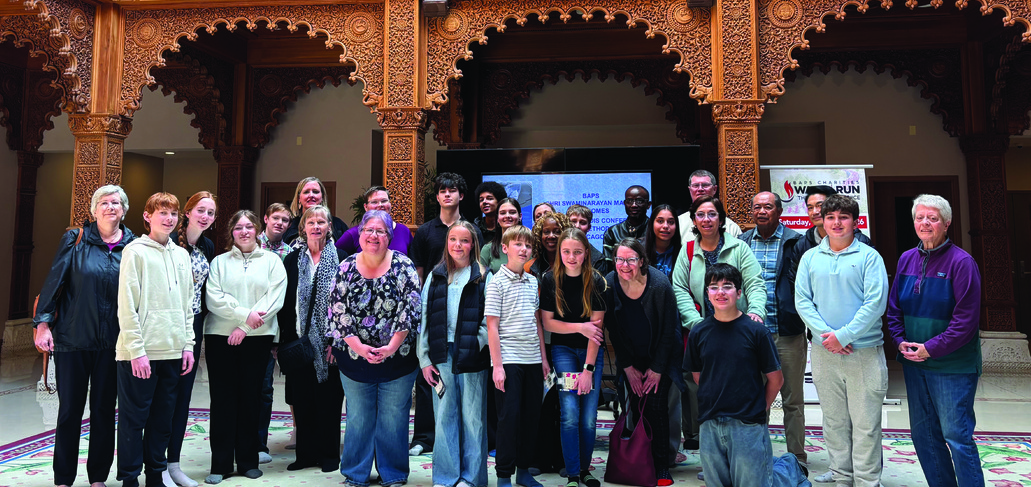
Nearly 40 Northern Illinois youth and adults traveled by van visiting various houses of worship. Their first stop was a Hindu mandir in Bartlett, Ill. Photo by Rev. Victoria Rebeck
About forty adults and youth from across Northern Illinois learned about a few of these faiths during the Who Is My Neighbor? NIC Youth Interfaith Bus Tour on April 18. They visited a Hindu mandir (worship and learning site), a Jain temple, a Buddhist temple, and a Sikh house of worship, all in the western suburbs of Chicago.
At the BAPS Shri Swaminarayan Mandir in Barlett, the United Methodist visitors were awed by the visual beauty that is an important part of the Hindu tradition. They were led into a large, airy haveli—a courtyard-like space—surrounded by intricately hand-carved teak and marble walls and columns. One youth, Chloe from Rochelle United Methodist Church, said she found this to be one of the more awe-inspiring aspects of the day’s trip.
The guide explained that faith, service, the family unit, nonviolence, and tolerance are Hinduism’s values. “Peace is at the heart of it,” he said. “It’s about how we live our lives.”
Over a billion people worldwide are estimated to practice Hinduism around the world, with most living in India. The religion is thousands of years old.
Hindus perceive that God is manifest in various ways and times (murtis). “Truth is one but told in many ways,” the guide elaborated. They also believe there are celestial beings with some powers—which non-Hindus may be familiar with—but these beings are all obedient to God.
They also believe in reincarnation, the soul’s journey through various lives until it reaches a place beyond suffering, at which point the soul’s journey is complete.
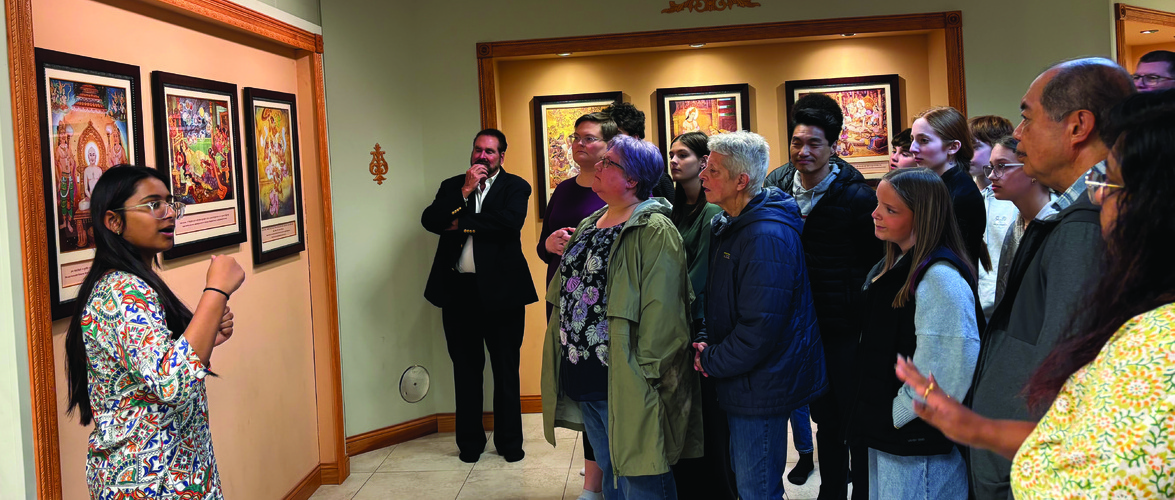
A youth guide describes to the United Methodist visitors some of the notable locations for Jain centers around the world. Photo by Rev. Victoria Rebeck
Next the group visited a community of faith that also has roots in India. At the Jain Society of Metropolitan Chicago in Barlett, the United Methodist learned that this faith’s foundation is right faith (understanding what is right), right knowledge, and right conduct. At the core is ahimsa—nonviolence in thought, speech, and conduct toward any life form. (For this reason, Jains following vegan dietary practices.)
“It is a way of life and a philosophy rather than a religion per se,” the guides explained. They follow the teachings and examples of 24 prophets that have taught over centuries. They, too, believe in the soul’s journey through various lives until it reaches “liberation” to an ultimate life of peace.
There are an estimated five million Jains in the world, including about 100,000 in the U.S. and about 5,000 in the Chicago area.
A third India-based house of worship visited by the group was the Illinois Sikh Community Center (or gurdwara) in Wheaton. This is faith was formalized in 1699 in the Punjabi region.
Its focus is on God as one creator. Worship practices include meditation on the name of the one creator. When the United Methodist visitors arrived, they experienced a portion of a service in which community members took turns reading aloud and singing through the entire Sikh scriptures, from Saturday through Sunday morning.
The guide explained that the word “sikh” means student. They believe that there is an equal spark of the divine in everyone, and thus see all people as equal. They do not observe caste and oppose sexism, he explained.
Three members of the Nichiren Shoshu Myogyoji Buddhist Temple in West Chicago taught the group about Buddhism. Like Jainism, this is not a theistic religion. Rather, adherents strive to emulate Buddha and overcome ego. Serving others is a practice toward overcoming ego, the guide explained.
The visitors experienced a chanting service, which the words “nam, myoho, renge, and kyo” were repeated. “It speaks to the causes that one wants to practice that can result in positive results,” affecting karma (the law of cause and effect), the guide said.
The United Methodist youth largely found their faith strengthened by the experience. Ben of Geneva United Methodist Church was struck by how close these faiths’ beliefs are, even amid their differences. The teaching that we can see God within ourselves and others and the principle of nonviolence—both values in Christianity—particularly resonated with him.
“People need to work on these more,” he said as a challenge to Christians to practice their beliefs.
Pedro of Our Redeemer’s United Methodist Church in Schaumburg said that “seeing how people view God and their history was a lightbulb moment. It developed my own Christianity.”
In her latest column, Rev. Fabiola Grandon-Mayer reflects on the Northern Illinois Conference’s Hispanic/Latinx ministries and the importance of celebrating and supporting these…
United Methodists and Muslim neighbors gathered Oct. 13 at Barrington United Methodist Church for the annual Methodist-Muslim Dinner, themed “Hope in Action: Standing Together Against Hate and…
The Northern Illinois Conference is accepting Equitable Compensation applications for the final 2026 disbursement and for the 2027 grant cycle. Churches and charges with a full-time…
Facebook business-page changes may affect how NIC churches share links to external websites, event registrations and ministry resources. Learn how your church can adapt its…