In Sympathy: Gwen Janet Oliver
Mrs. Gwen Janet Oliver, spouse of Rev. Richard E. Oliver, retired member of the Northern Illinois Conference, passed away on Fri., Oct. 2, 2026.
Our journey of making our First United Methodist Church at the Chicago Temple creation-care friendly began in 2021. That year, we embarked on a challenging and rewarding journey to eliminate our use of energy from fossil fuels to help the environment.
Over a five-year period we took the following steps:
-crop-355x466-b70dc.jpg)
Cathie Lowmiller shows off the church's new heat pump water heater.
We have saved all the money we were spending on natural gas. Because we are using more electricity, our electricity cost is somewhat higher. However, because heat pumps are much more efficient than gas systems, our total energy use (gas plus electricity in kWh equivalent) has decreased by more than 66 percent ([47602 kWh-16398 kWh]/ 47602 kWh = .66).
Our total energy cost also decreased, but because the energy-equivalent cost of electricity is currently higher than that of gas, our decrease was only about 36% ([$272-$173]/$272 = 0.36).
However, if the environmental impact is considered, the savings are immeasurable.
The largest reduction in our total energy consumption is attributable to our change to air-sourced heat pumps for heating and cooling (HVAC). In 2022, the last full year that we had gas furnaces, our total energy use was approximately 47600 kWh (equiv.). In 2024, first full year that we had air sourced heat pumps, our total energy consumption was approximately 16400 kWh. This energy savings reduced our CO 2 emissions by approximately 6.0 metric tonnes per year. Because the heat pumps are so important to reducing emissions it is worth noting some of our experiences with purchasing and operating them.
First, it is very important to find an HVAC company that has significant experience installing residential heat pumps in your area. We chose a company that has a very good reputation for sales and service of residential A/C and is an authorized dealer for the brand of heat pump we chose. We didn’t dig deeply enough into the company’s experience with heat pumps.
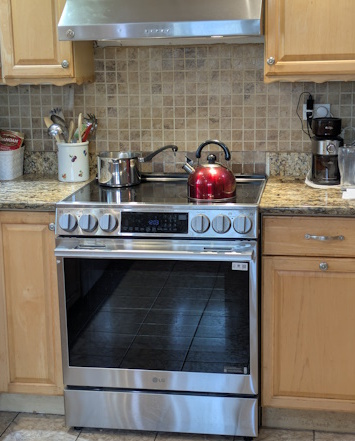
The church installed an efficient induction cook-top range.
The installation of a heat pump system is more complex than the installation of a typical air-conditioning system, although they look the same on the surface. A modern heat pump system has to be set up properly in order to function correctly in heating mode in the winter. Our systems were installed in August. They functioned quite well as air conditioners, and even as heating until December. Then we began to have problems with the outside units building up thick coatings of ice. The systems are supposed to run defrost cycles, much the same as your refrigerator runs defrost cycles. As it turns out, the systems had not been completely set up.
Several important adjustments should have been made to parameters stored in the system controllers, but they were not. After several warranty service calls the company’s technicians (with my assistance) got the systems adjusted properly, and they have worked quite well ever since. Although the company and its service technicians were very responsive and courteous, it became obvious that the company did not have adequate experience or training in installing the residential heat pump that they are authorized to sell.
Second, as wonderful as they are, residential heat pumps are not good at one particular thing. They cannot (in pure heat pump mode) raise the temperature of your home quickly during the winter. They are very good at holding temperature efficiently.
All heat pump systems have auxiliary heating built into them. In an all-electric heat pump the auxiliary heaters are conventional “resistance” heaters much like those in small portable room heaters. That type of heater is effective but not very efficient. Nevertheless, heat pump systems need them for two reasons. They are required for the defrost cycles that must be run occasionally when the outside air temperature gets below about 40 ○ F. They are also required to assist the heat pump when the outside air temperature gets below the minimum temperature that the system is designed for, about 15 ○ F in our case, or when the user demands that the indoor temperature be raised quickly, regardless of the outside air temperature. When using heat pumps for heating It is counterproductive to allow the temperature inside the home to cool significantly (by more than about 5 or 6 degrees) then force the heat pump system to bring the temperature back up over a short period of time. Doing so forces the system to turn on auxiliary heat for extended periods. Since the auxiliary heaters are only 40% as efficient as the heat pump, this can be quite expensive.
-crop-355x344-a94bc.jpg)
A heat-pump clothes dryer is another energy-saving appliance the church installed.
The lesson here is to not take the conventional advice to turn your heat pump setpoint down radically when you leave the house in the morning in the winter then bring the temperature back up quickly when you get home. Adjusting the setpoint down modestly, by four or five degrees, is OK, but don’t try to make the system bring the temperature back up at a rate of more than about 2 degrees per hour. This advice applies only to winter. In the summer, heat pump systems are by their nature very efficient air conditioners. There is no auxiliary heat to worry about. Following the advice to make large adjustments the A/C setpoint when your home is unoccupied in the summer will save money and energy.
Overall, we are very pleased with our decision to replace our HVAC systems with heat pumps. We definitely see an operating cost savings, and the knowledge that we are reducing harmful emissions by more than 66 percent is very satisfying.
Mrs. Gwen Janet Oliver, spouse of Rev. Richard E. Oliver, retired member of the Northern Illinois Conference, passed away on Fri., Oct. 2, 2026.
October is Pastor Appreciation Month, an opportunity to recognize the pastors and clergy who serve congregations and communities throughout the year. From writing a personal…
In an effort to be more transparent, the Finance and Administration office is going to be consistently sharing where we are as a conference are in regards to the giving versus what is needed fo…
More than 250 clergy from Wisconsin and Northern Illinois gathered at Green Lake for three days of leadership development, connection and innovation, exploring new ways…