In Sympathy: Man Singh Das
Rev. Man Singh Das, a retired member of the Northern Illinois Conference, passed away on October 7, 2026.
Intercultural competency—the ability to interact effectively and appropriately with people from different cultural backgrounds—requires understanding, respect, and adapting to cultural differences. Because Northern Illinois is a diverse conference, the Annual Conference Shepherding Team took intercultural competency training on July 25 at Our Saviour’s United Methodist Church in Schaumburg, led by Rev. Dr. Grace Pak.
“As leaders representing the conference, we have to try to know something about the conference’s various cultures,” said one participant.
Also invited to the training were the cabinet, the Nominations Committee, Council on Finance and Administration, Board of Trustees, and Board of Pensions.
The Bible has many examples of people encountering others of different cultures. Participants could identify several examples from memory.
“God expects us to be diverse and we are diverse regardless of choice; it is the way God created the world,” a participant observed. Another noticed that the biblical witness demonstrates that relating across diverse cultures is not a new phenomenon.
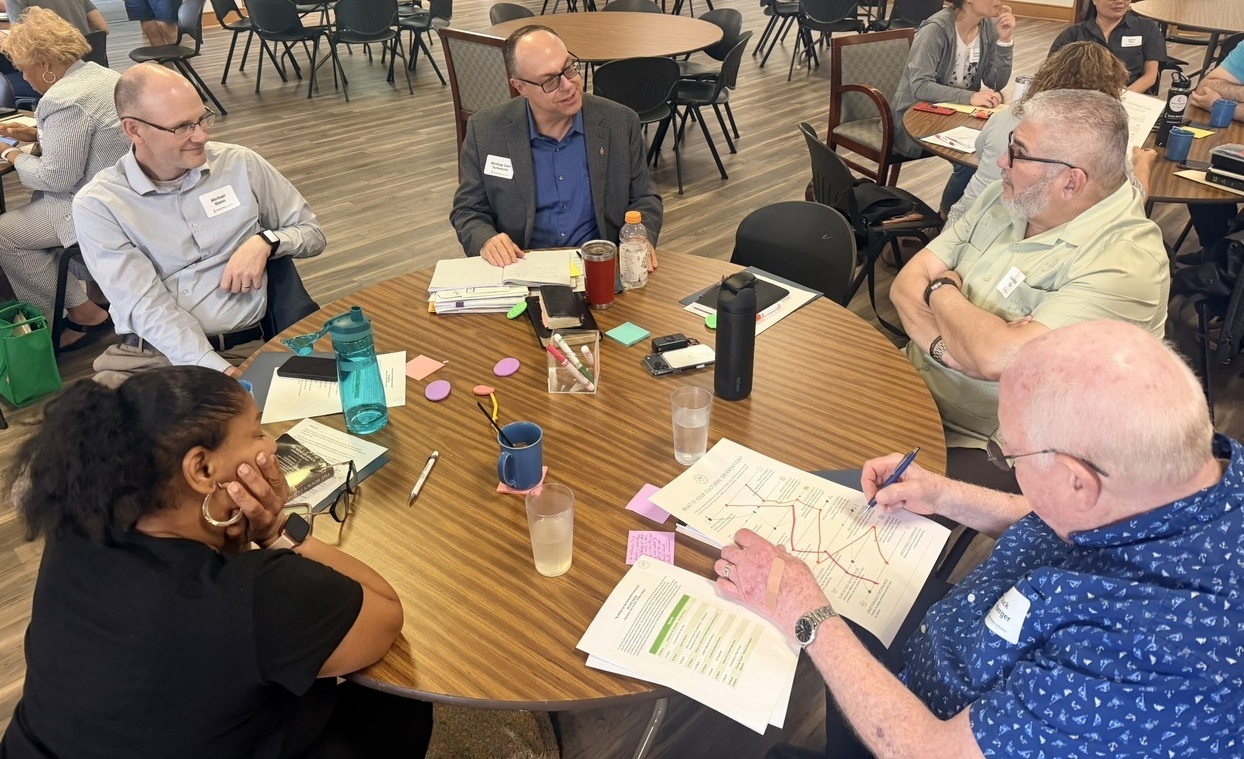
Members charted their own cultural practices in key areas of communication, group work, and more.
Rev. Dr. Pak offered three definitions of culture:
Culture is “the collective programming of the mind distinguishing one group from the other.” (Geert Hofstede)
“Culture is the shared ways in which groups of people understand and interpret the world.” (Fons Trompenaars)
“Culture hides more than what it reveals, and strangely enough, what it hides, it hides most effectively from its own participants.” (Edward T. Hall)
Cultural competency lies in knowing how to bridge the difference between one’s own culture and awareness of another culture, Rev. Dr. Pak explained.
She pointed out a few areas of cultural difference that can result in conflict if there is a lack of awareness, she explained.
One has to do with understanding of time commitments. Monochronic culture holds that punctuality is important and everyone should be on time according to the clock. Polychronic culture holds that what happens during the time period is more important than when it starts or ends.
Another area is communication. In low-context cultures, communication is straightforward, explicit, and detailed. The meaning is in the words. In high-context cultures, communication is multi-layered and nuanced. Much is understood without having to be said.
Individualistic vs. collectivistic societies differ in how they emphasize the individual and the community. In collectivist cultures, individuals prefer not to be singled out for recognition. One’s actions and decisions are determined by the community’s needs. Individualistic cultures prefer to recognize individuals for their work. One’s actions and decisions are determined by one’s own needs.
In low-power distance and high-power distance cultures, people of higher rank, position, or status are treated differently. For example, in a low-power-distance society, people may call someone in a higher rank by their first names. In high-power-difference societies, people in a higher rank are more likely to be addressed and referred to by their title or rank.
There is also a distinction between task-focused vs. relationship-focused ways of accomplishing a project, especially when more than one person is involved. In a task-focused culture, people tend to prefer to follow an agenda and prioritize completing a job. They can become impatient with socializing. Relationship-focused cultures value spending time building relationships and work together better once relationships are established.
Some cultures prefer surfacing differences so that problems can be solved more quickly. Others prefer maintaining harmony, dealing with differences indirectly and behind the scenes in order to avoid conflict.
Another area of cultural difference relates to expression of emotions. Emotionally restrained cultures prefer that people keep emotions private and in check. Emotionally expressive cultures believe that expressing emotion is necessary for fully communicating meaning.
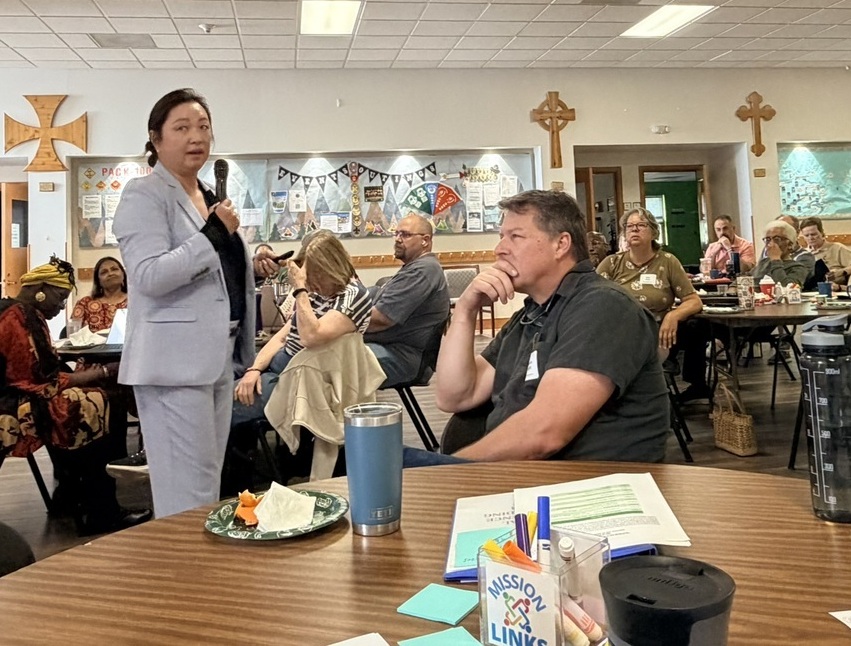
Rev. Dr. Grace Pak led participants to consider some challenging questions.
“We can’t know everything, but if we can know a few things, we are at a good starting point,” Dr. Pak said.
The willingness to adapt to others’ cultures is an important step toward bridging the gap, she said. It demonstrates respect for another’s cultural practices.
“Cultural interaction is mutually formative,” Dr. Pak added. “When we relate with openness and willingness to adapt, we can create something new that reflects something of Jesus’s love.”
ACST members took the Intercultural Development Inventory to determine where the group was as a whole on a five-part continuum of intercultural competency. The group fell into the middle category of minimization.
This reflects a tendency to highlight commonalities across cultures, which can mask important cultural differences in values, perceptions, and behaviors. The group’s strength is that it has likely found some success in interacting with people from cultures different from its own by focusing on commonalities. This also presents a challenge; the group may struggle to bridge diverse communities when differences that need to be more deeply understood and acknowledged are present.
Groups and individuals can take steps to advance in their cultural proficiency and the conference offered to help those who took the IDI to receive coaching.
ACST members expressed the concern that “we have a lot of work to do” while committing to the continuing work and attention needed to grow in cultural competency.
“Jesus came to change the culture to make it the same as the culture of heaven,” Rev. Dr. Pak said. “We begin to create the heaven culture around us. The intercultural competency work will help us. What’s most important is mindset: It’s not about us but about others.”
Rev. Man Singh Das, a retired member of the Northern Illinois Conference, passed away on October 7, 2026.
Four leaders from the Northern Illinois-Wisconsin Episcopal Area will participate in the Council of Bishops’ Leadership Gathering Oct. 20–24 in Calgary, Canada, joining United Methodis…
The 2026 Bishop’s Appeal: Education for the Central Conferences raised $32,247.40 to expand educational opportunities in Tanzania and support theolo…
United Voices for Children brought advocates, church leaders and community partners together for its annual Raising Our Voices event on Sept. 24 at Grace UMC in Rockford, focusin…