Four Leaders Head to Global UMC Gathering
Four leaders from the Northern Illinois-Wisconsin Episcopal Area will participate in the Council of Bishops’ Leadership Gathering Oct. 20–24 in Calgary, Canada, joining United Methodis…
2026 is a year of significant ministry anniversaries in The United Methodist Church, for full clergy rights for women (70 years), UM Volunteers in Mission (50 years), the Northern Illinois Conference's decision to become a Reconciling Conference (40 years), and the establishment of the order of deacons (30 years). Northern Illinois Conference celebrated these on June 15.
(Information from the General Board of Higher Education and Ministry)
Watch the NIC Presentation at AC 2026
UM Volunteers in Mission is a grassroots movement of United Methodists who seek to put their “Christian love in action.” Since the 1970s, UMVIM has offered a framework through which disciples can engage in short-term mission locally, nationally, and globally. Volunteers are lay and clergy, young and old, with differing abilities and vocations, from all walks of life. Tens of thousands of United Methodists engage in short-term mission each year in ministries as varied as disaster response, community development, pastor training, microenterprise, agriculture, vacation Bible school, building repair and construction, and medical/dental services.
UMVIM emphasizes matching people with opportunities because we believe that God calls all Christians “to bring good news to the oppressed [and] to bind up the brokenhearted” (Isaiah 61:1) and to love their neighbors as themselves. They believe that the neighbors we are called to love exist both next door and halfway around the world.
In 1986, the Northern Illinois Annual Conference made history by voting to become the first annual conference to join the Reconciling Ministries Network as a reconciling conference. The Wisconsin Annual Conference adopted a resolution suggesting that its local churches consider becoming reconciling congregations.
Reconciling Congregations began in September 1982 at a meeting of Affirmation: United Methodists for Lesbian/Gay Concerns in Boston, which approved the idea of “developing a program in which local churches will declare their support for the concerns of lesbians and gay men." The model of the More Light Program, begun in 1978 by the Presbyterians for Lesbians and Gay Concerns, of a local church adopting a statement affirming lesbians and gay men and inviting their full participation in the life of the local church, was adapted for United Methodist congregations.
Discussion about the need for “reconciliation” between The United Methodist Church and lesbians/gay men at a November 1982 meeting of Affirmation’s General Conference Task Force inspired the name “Reconciling Churches.” This was modified to “Reconciling Congregations” in order to clearly emphasize that this would be a local church network.
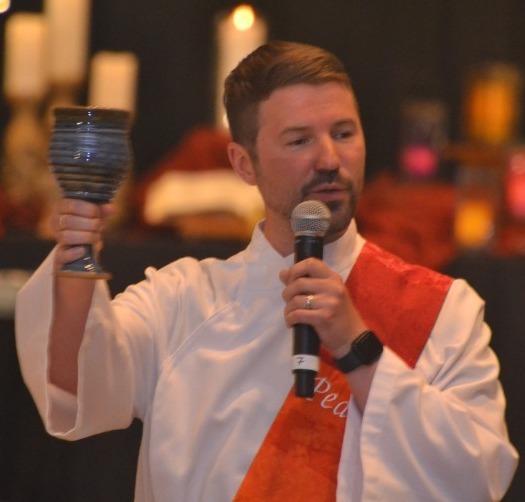
Deacons are ordained and elected into full clergy membership in ministries of Word, Service, Compassion, and Justice. They serve as Christian educators, outreach ministers, missions leaders, social workers, chaplains, denominational leaders, and in places where God's love meets the world. They lead the church outside of its walls and into mission and ministry.
For many years, The United Methodist Church's pattern of ordination and clergy membership was initially to ordain those called to pastoral ministry first as deacons and election to probationary membership and then as elders and election to full membership in the annual conference. In 1976, following an ecumenical movement to revive the ancient and distinct order of the diaconate, the lay role of diaconal minister was created. Diaconal ministers connected lay people to their ministries in the world and assisted the elder at baptism and communion. They served as Christian educators, ministers of music, youth pastors, and other roles in the church, as well as in serving ministries outside of the congregation.
In 1996, after a time of study of ministry, the General Conference approved the ordained order of deacons and eliminated the two-step ordination process for elders.
Four leaders from the Northern Illinois-Wisconsin Episcopal Area will participate in the Council of Bishops’ Leadership Gathering Oct. 20–24 in Calgary, Canada, joining United Methodis…
The 2026 Bishop’s Appeal: Education for the Central Conferences raised $32,247.40 to expand educational opportunities in Tanzania and support theolo…
United Voices for Children brought advocates, church leaders and community partners together for its annual Raising Our Voices event on Sept. 24 at Grace UMC in Rockford, focusin…
More than two dozen United Methodists from six conferences explored the region’s Methodist history during an Oct. 7 tour through Iowa, Illin…