Bishop's Appeal Update: Advancing Educational Opportunities Around the World
The 2026 Bishop’s Appeal: Education for the Central Conferences raised $32,247.40 to expand educational opportunities in Tanzania and support theolo…
More than two dozen people from across the North Central Jurisdiction traveled into three states – Iowa, Illinois and Wisconsin – on Wednesday, Oct. 7, digging deep into the history of Methodism in the region and visiting historic church sites.
Participants in the day-long tour, that started and ended in Dubuque, Iowa, represented UMC Conferences in Wisconsin, Michigan, Iowa, Illinois, Minnesota and Ohio. Stops along the route, travelled via coach bus, included in Galena, Ill., and Platteville, Mineral Point and Linden, Wis.
The event was part of the NCJ’s Annual History & Archives Convocation, Oct. 5-8, in Dubuque.
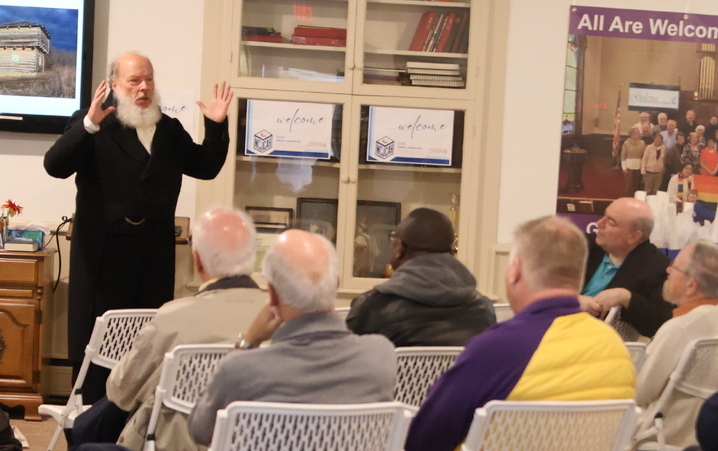
Rev. Dr. Daniel Swinson shared preaching traditions at Galena UMC. Photo by Karyn Saemann.
At Galena United Methodist Church, presenter Rev. Dr. Daniel Swinson shared that he was outfitted “in the most approved Methodist preacher style” of 1825.
“This was very conservative dress in 1825,” with a coat, vest, trousers and a ‘very modest' go-to-meeting hat,” he said.
A preacher's clothing had to stand up to traveling long distances, by horseback or on foot, and weather the elements and natural obstacles like needing to ford streams.
Methodist preachers in the early 1800s also had to manage expectations for worship in an era when tensions were high regarding how services should be conducted.
Generally, Swinson said, worship consisted then of a hymn, prayer, reading of the scriptures and a sermon if a preacher was available.
“If not, there might be speaking or exhortation,” Swinson said.
“There were licensed exhorters... people who would follow the sermon with an application to the people. How does this apply to you?” he explained.
Exhorters aimed for an emotional response.
“If you went away untouched from a Methodist service, it was not a Methodist service. You had to at least have tears,” Swinson said.
Singing, he further explained, “was done in a very different fashion from the way that we do it today.”
“First, the leader would read the entire hymn. All six verses.”
There were no instruments; hymns were to be sung in a cappella.
“Next, you would announce the tune and then – very important – you would pitch the tune. You give the first note. Methodists had what they called sweet singers, people who could do this,” Swinson continued.
Prayer, he went on, “would have been extemporaneous. A cry to the Holy Spirit to be active.”
The service would close with the apostolic blessing, “which was the approved Methodist benediction. At which point the preacher would go to lead class meeting.”
There was no public offering; collection happened in the class meeting.
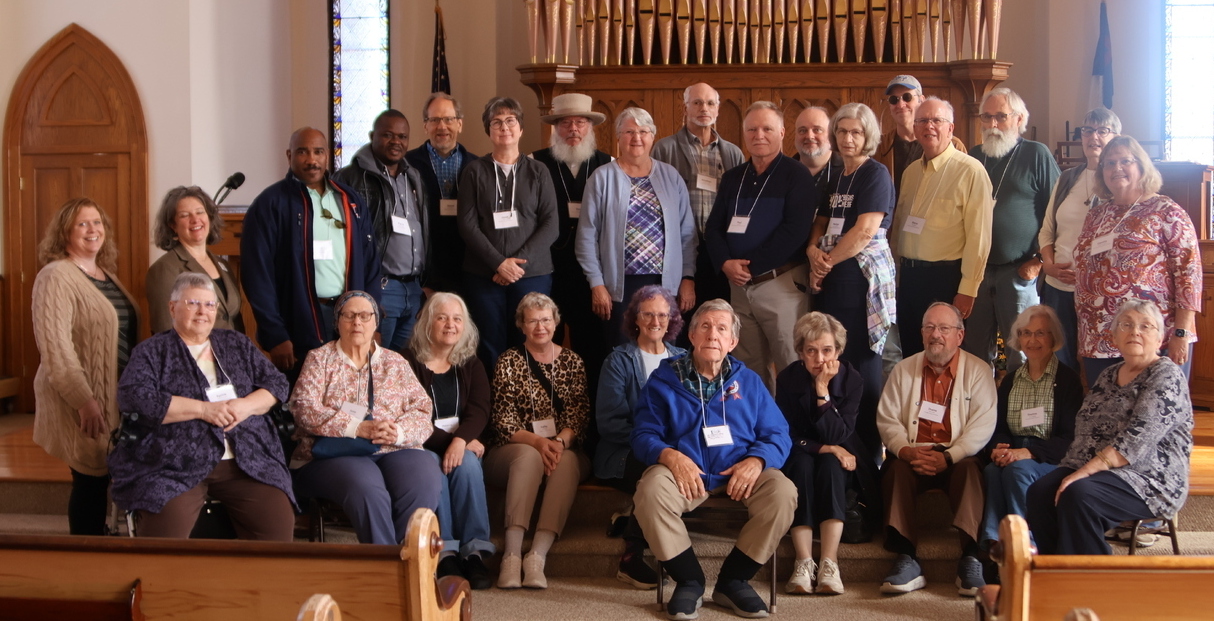
Participants took time for a group photo in Mineral Point UMC. Photo by Karyn Saemann.
In Platteville, attendees enjoyed lunch at Platteville United Methodist Church and heard a presentation by James Hibbard, an archivist at the University of Wisconsin-Platteville.
Hibbard shared the story of Rev. Samuel Mitchell, a Revolutionary War veteran from Virginia who freed his slaves in 1790 before coming to the Platteville area in the 1830s as a Methodist Episcopal preacher.
“Slavery was inconsistent with Christianity, was the way he looked at it,” Hibbard said.
After later living for a time in the St. Louis area, he passed away and his family buried him in Platteville.
The historical record shows that at least some of his descendants were of a different mind on slavery.
After slavery was outlawed in Wisconsin Territory in 1838, both his son and his son-in-law faced scrutiny from abolitionists, as they continued to either own slaves or to employ indentured Black servants.
Some servants were moved to Chicago and St. Louis, effectively sidestepping Wisconsin law, as anti-slavery sentiment mounted in advance of the Civil War.
Hibbard’s research that followed the family for several generations relied on a mix of sources including memoirs, probate files, property-tax rolls, court cases, census records, church records, newspapers, cemetery records, and architectural history.
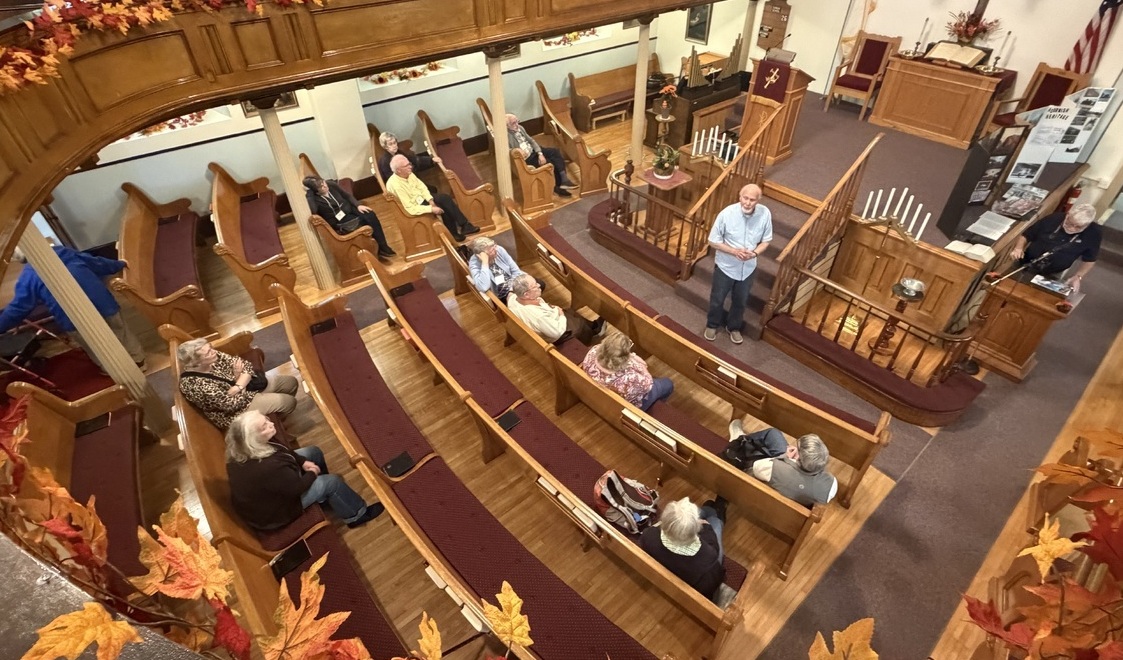
Members at Linen UMC shared about the building's design and construction. Photo by Karyn Saemann.
In Linden, two members of Linden United Methodist Church, that’s on the National Register of Historic Places and this year is celebrating its 175th anniversary, shared about the building, its design, its construction and the congregation.
The church was completed in 1850 and dedicated in 1851. Its steeple, bell and clock tower were removed this year, as their weight threatened the structure.
Its founders were miners from Cornwall and Yorkshire, England.
“Both of those ethnic groups came from a strong Methodist background. So, they got along well here, and they formed the nucleus of the early church,” said Jim Jewell, a member of the church who teamed with fellow church member Stan Cutler on a presentation in the original historic sanctuary.
“And the fact that this building is still standing after 175 years, it's a testament to the builders. It's also a testament to the congregation who have lovingly taken care of it,” Jewell continued.
Over the generations, “two events that really brought the community together within the walls of this church,” have been Christmas Eve service and Harvest Festival, Jewell continued.
Historically for Christmas Eve, “they would have a large Christmas tree in here, and they would have Santa Claus, and they would have presents for all of the Sunday School kids,” he said.
Just up the street is a village park, where baseball has long been played.
“It’s fortunate these stained-glass windows are still here,” Jewell said, given the proximity of the baseball field.
The 2026 Bishop’s Appeal: Education for the Central Conferences raised $32,247.40 to expand educational opportunities in Tanzania and support theolo…
United Voices for Children brought advocates, church leaders and community partners together for its annual Raising Our Voices event on Sept. 24 at Grace UMC in Rockford, focusin…
More than two dozen United Methodists from six conferences explored the region’s Methodist history during an Oct. 7 tour through Iowa, Illin…
In a pastoral letter to United Methodists around the world, Bishop Ruben Saenz Jr., writing on behalf of the Council of Bishops, opposes plans to livestream the exec…