Stonger Together: Beyond Hispanic Heritage Month
In her latest column, Rev. Fabiola Grandon-Mayer reflects on the Northern Illinois Conference’s Hispanic/Latinx ministries and the importance of celebrating and supporting these…
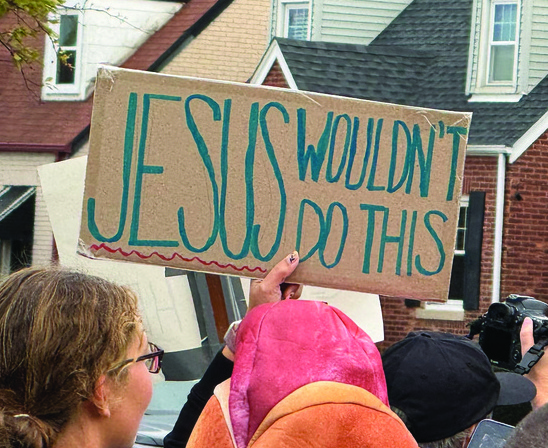
Photo courtesy of Rev. Britt Cox
On Oct. 5, I was alerted that Immigration and Customs Enforcement agents were tossing tear gas canisters out of windows in Logan Square, the northwest Chicago neighborhood where my church is located. They were aiming at rapid response coordinators who were trying to warn neighbors about ICE’s presence. In a brazen disregard for public safety, ICE agents tossed the chemical munitions out of their car next to a busy elementary school and a nearby stroller.
Though horrified, my church members were quickly able to mobilize folks to go to the scene to help those injured as well as share information about how to treat chemical munition injuries that we had learned from other rapid responders. We had built our rapid response and trained for this moment.
A month ago, the first time that President Donald Trump threatened to send the National Guard to Chicago, United Methodists began preparing for how we would resist and keep each other safe. In coordination with Bishop Schwerin and Rev. Fabiola Grandon-Mayer, we started by building a Chicagoland United Methodist Rapid Response communication channel where we could share information, needs, events, and skill-building and training opportunities.
The goals of this group are to live into our connectionalism, which in this instance means if someone come for one United Methodist, you come for us all; to use our denominational structure as a centralized place to build out rapid response capacity in churches; and to set a model for others on how we can use denominational infrastructure to respond to moments like this.
Now we are seeing United Methodists show up, according to their conscience and capacity, all over the area to provide prophetic witness, disrupt the empire, and care for our immigrant neighbors. This is the heart of Wesleyan theology after all: that we are people so haunted by God’s grace in our lives that we cannot help but be grace in our communities.
To live and be discipled in a way where, to paraphrase Rev. Martin Luther King Jr, we are less concerned with what will happen to us if we stand up than what will happen to our neighbor if we don’t. It may feel hopeless, but there are so many of us, eyes stinging from tear gas and bodies sore from rubber bullets, standing resolutely on what we know to be true: that immigrants are made in the image of God and our city is not our city without them.
In her latest column, Rev. Fabiola Grandon-Mayer reflects on the Northern Illinois Conference’s Hispanic/Latinx ministries and the importance of celebrating and supporting these…
United Methodists and Muslim neighbors gathered Oct. 13 at Barrington United Methodist Church for the annual Methodist-Muslim Dinner, themed “Hope in Action: Standing Together Against Hate and…
The Northern Illinois Conference is accepting Equitable Compensation applications for the final 2026 disbursement and for the 2027 grant cycle. Churches and charges with a full-time…
Facebook business-page changes may affect how NIC churches share links to external websites, event registrations and ministry resources. Learn how your church can adapt its…